%202.png)
Best Water Damage Restoration Company in Los Angeles: 7 Compared (2026)

By Asher Ben-Haim. Updated September 2026.

Most of the companies that come up when you search for the best water damage restoration company in Los Angeles do one part of the job. They extract the water, dry the structure, and tear out what can't be saved. Then they leave. Putting your home back together, meaning the drywall, flooring, cabinets, and finishes, is construction work. In California that work almost always requires a licensed contractor. For a rebuild that touches more than one trade, that means a Class B General Building license, the CSLB classification for contractors whose work spans two or more building trades. At Built to Perfection, we're a licensed general contractor (CSLB License #837987) and an IICRC Certified Firm (#70224833), so we take water damage jobs from drying and remediation through reconstruction under one contract. We've been building in Los Angeles since 2001.
This roundup covers seven Los Angeles water damage companies, grouped by what each one actually does. Before the list, we explain the difference between mitigation and rebuild. After it, we give you a five-minute process for checking any company's license and certification yourself. If you're reading this with wet drywall in the next room, skip to the verification section and come back to the list after.
How do you pick the best water damage restoration company in Los Angeles?
The best water damage restoration company in Los Angeles is one that holds both an IICRC firm certification and a CSLB license class that covers reconstruction, so it can take the job from drying through rebuild under one contract. So ask two things. Can the company carry the job all the way through reconstruction, and can you confirm that on the California Contractors State License Board (CSLB) website? A company that answers yes to both saves you from hiring twice, and from the gap between the crew that dries your home and the crew that rebuilds it.
Everything else is secondary. A response-time promise isn't a credential. A review count tells you how well a company manages its online presence. It doesn't tell you whether the company is licensed to frame a wall. Here's what we'd check, in order.
What water mitigation, remediation, and reconstruction actually mean
"Restoration" gets used loosely in this industry. The reference standard for professional water damage work is the ANSI/IICRC S500 Standard for Professional Water Damage Restoration, and under that standard, restoration runs from inspection through drying and structural restoration. In practice, plenty of companies that call themselves restoration companies stop well before the repair. So it helps to break the job into three phases and ask any company which ones it contracts for.
In Los Angeles, the losses we see most often are slab leaks, corroded galvanized or cast iron pipe in mid-century homes, sewer backups, water heater and appliance failures, roof leaks, and storm intrusion during heavy rain. The phases are the same for all of them.
Mitigation is the emergency phase. The crew stops the damage from spreading, extracts standing water, sets drying equipment, and removes materials that can't be saved. Wet drywall, soaked carpet pad, swollen baseboards, and cabinets that have wicked up water usually come out. The EPA notes that wall cavities are particularly hard to dry, which is why tear-out is so often part of this phase.
Remediation is the moisture and mold phase. The crew dries the structure to a measured standard, treats or removes materials affected by mold, and confirms with moisture readings that the home is ready to close up.
Where the water came from matters here. S500 sorts water into three categories, from clean supply-line water (Category 1) to grossly contaminated water such as sewage or floodwater (Category 3), and a Category 1 leak degrades toward Category 2 or 3 the longer it sits.
In March 2026 the IICRC issued a position statement clarifying that rain and other weather-related water entering from above is not automatically Category 3. A competent contractor inspects the source and the path before assigning a category, because the category drives the scope.
Reconstruction is construction. Framing, insulation, drywall, plumbing and electrical repairs, flooring, cabinets, tile, paint, and trim all go back in. This phase requires a general contractor. The CSLB defines a Class B General Building contractor as one whose work involves two or more unrelated building trades, which describes nearly every water damage rebuild.
Nothing in S500 or California law requires you to hire two separate companies, and several of the franchises on this list advertise reconstruction. But many of the companies ranking for this search are mitigation-only and refer the rebuild out, and some don't say so until the drying equipment is packed up. That's where homeowners get stuck. Some of the hardest conversations we have at Built to Perfection are with homeowners whose home has been dry for weeks and still has no walls, because the first company finished its scope and the second one hasn't started. We run every job on one principle. Nothing gets demolished until everything needed to finish that phase is in hand, and the crew works straight through to completion. On a water damage job, that means the same license covers the tear-out and the rebuild, and there's no open wall waiting on a second contractor.
Water damage restoration companies in Los Angeles: 7 compared by what they cover
Each entry covers what the company offers, whether it rebuilds, its service area, and its public credentials. License numbers are the ones each company publishes. Look them up using the steps below, since status and classifications change. We left out review counts and star ratings. A license record tells you more.
Local mitigation-only company
Bolt Restoration Inc (Los Angeles, 90011)
What it does: Water extraction and cleanup, mold remediation, fire and smoke cleanup, selective demolition, board-up, and contents pack-out. Advertises 24/7 emergency service.
Rebuild: No remodeling or multi-trade reconstruction service is advertised.
Service area: Based in Los Angeles. County-by-county coverage isn't stated.
Public credentials: CSLB #1153732, a C-61 Limited Specialty license with an approved scope of water, fire, and mold remediation, issued April 2026. The company says its technicians are IICRC certified; confirm Certified Firm status on the IICRC locator. The company states it was established in 2025.
The state itself draws the line here. A C-61 Limited Specialty license covers only the specific work the CSLB approved for it. It does not cover a multi-trade rebuild.
National restoration franchises with Los Angeles locations
SERVPRO of Wilshire Center (Los Angeles, 90010)
What it does: Water damage restoration, fire restoration, mold remediation, storm response, and construction services.
Rebuild: Construction services are listed on the local page.
Service area: Wilshire Center and central Los Angeles.
Public credentials: Publishes CSLB #991312. Confirm the classification and status on the CSLB record. States its crews are IICRC certified; confirm Certified Firm status for the franchise entity.
ServiceMaster Restoration by EMT (Los Angeles County, Paramount area)
What it does: Extraction, mitigation, dehumidification, mold remediation, fire restoration, contents and pack-out, and reconstruction.
Rebuild: Yes. Reconstruction is advertised on the local site.
Service area: Los Angeles County.
Public credentials: Publishes CSLB #1008628. Confirm the classification and status. Check the IICRC locator by the legal entity name for Certified Firm status.
911 Restoration of West LA and Downtown LA (Culver City)
What it does: Water damage, mold remediation, sewage cleanup, and fire and smoke restoration.
Rebuild: The national brand advertises full reconstruction. Whether this location contracts for reconstruction locally isn't stated. Ask.
Service area: West Los Angeles and Downtown Los Angeles.
Public credentials: CSLB #1075169 per its BBB profile, which lists a business start date of April 2021. Confirm the classification and status. IICRC Certified Firm status not confirmed.
BELFOR Property Restoration, Los Angeles office (operating from Anaheim)
What it does: Water extraction, dehumidification, mold removal, contents, and reconstruction and general contracting.
Rebuild: Yes, per the company's Los Angeles page.
Service area: Greater Los Angeles metro area.
Public credentials: The company states it is an IICRC Certified Firm; confirm on the locator. Ask for the CSLB license number of the BELFOR entity that would sign your contract and look it up before hiring.
ATI Restoration, Los Angeles office (near LAX, headquartered in Anaheim)
What it does: Mitigation, remediation, and residential and commercial reconstruction. The company describes its rebuild scope as running from permits through framing, finish work, and final inspection.
Rebuild: Yes, per the company's Los Angeles reconstruction page.
Service area: Los Angeles, Ventura, and Santa Barbara counties, per its office page.
Public credentials: Publishes CSLB #1075543 on its Los Angeles office page. Confirm the classification and status on the CSLB record. IICRC Certified Firm status not confirmed.
Local general contractor with IICRC firm certification
Built to Perfection, Inc. (Canoga Park)
We're the entry that's a general contractor first and a restoration firm second. Everything below can be checked.
In business since 2001. 25 years of Los Angeles construction experience, family-operated by Asher Ben-Haim, Tomer Ben-Haim, and Roi Yehuda. The people whose names are on the door are on the projects.
CSLB License #837987, Class B General Building, active, with a $25,000 contractor bond on file.
IICRC Certified Firm #70224833 for water and fire damage restoration.
EPA Lead-Safe Certified Firm, RRP #LBP-F307833-1. This matters in homes built before 1978, which is a large share of the Los Angeles housing stock. Demolition and reconstruction that disturbs painted surfaces in those homes has to follow lead-safe work practices.
BBB A+ accredited since February 2016.
8-time Best of Houzz Service winner (2015, 2016, 2017, 2019, 2020, 2023, 2025, and 2026).
We handle the full scope of water damage restoration, from drying and remediation through reconstruction, under one contract and one license. That covers active leaks and recent floods, slab leak repair and reconstruction, sewer backup remediation, mold remediation tied to water damage, and full reconstruction after remediation. The same firm certification covers fire damage restoration, and we're currently rebuilding homes in Altadena and Pacific Palisades, which is a fair measure of reconstruction capacity if your loss is a large one.
Service area: Los Angeles County and Orange County. Office: 21201 Victory Blvd #235, Canoga Park, CA 91303. Phone: (888) 955-0535. Scope and process details are on our water damage restoration page.
At a glance: who does what
How to verify any water damage company in Los Angeles before you sign
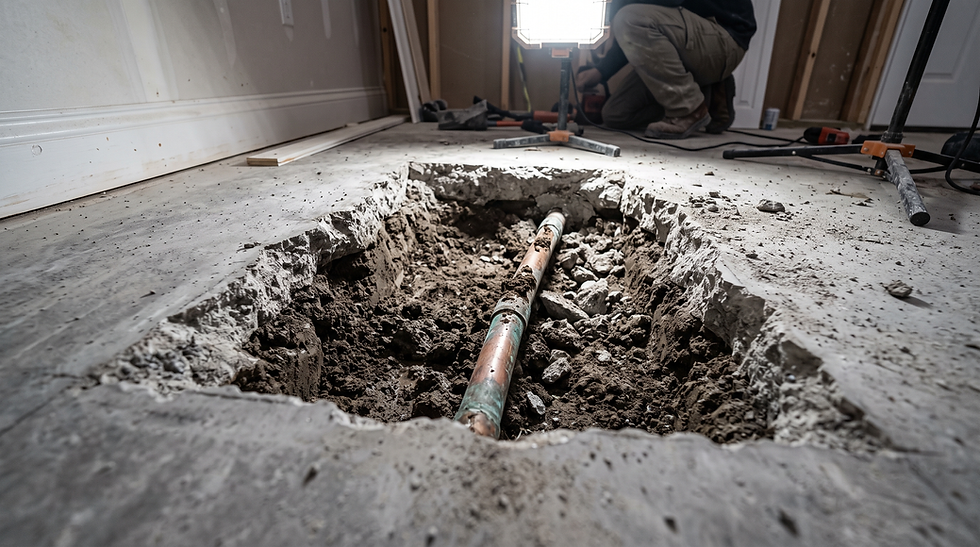
In 25 years of building in LA, the calls we get after a slab leak usually start the same way. The mitigation crew has come and gone, the slab is cut open, and the homeowner has just learned that the company that dried the house doesn't rebuild houses. The checks below take about five minutes and would have caught that before the first invoice.
Look up the license on the CSLB website. Use CSLB Check a License. You want status ACTIVE, a legal entity name that matches the name on your contract, a $25,000 contractor bond, and workers' compensation coverage or a valid exemption. The record also shows complaint disclosures.
Confirm the license class covers reconstruction. For a rebuild involving framing, drywall, plumbing, electrical, and finishes, that means Class B General Building. A C-61 Limited Specialty license with a remediation scope, or an IICRC certificate on its own, does not authorize a multi-trade rebuild.
Confirm IICRC Certified Firm status. Search the IICRC Global Locator by the legal business name. "IICRC-certified technicians" on a website is not the same as the contracting entity being a Certified Firm.
Check Lead-Safe certification if your home was built before 1978. Use the EPA's certified renovation firm search.
Ask who does the rebuild, and under whose license. If the answer is "we'll refer you to someone," get that contractor's name and license number now, not after the drying equipment leaves.
Ask what happens between the dry-out and the rebuild. Who is responsible for the home in the gap? Who holds the moisture readings? When does the second phase start, and is that in writing?
Ask for the permit plan. Inside the city, the Los Angeles Department of Building and Safety (LADBS) requires building permits for alterations and demolition. Its express permit list includes replacing drywall with no new walls added in single-family homes and duplexes, so even a modest rebuild is permitted work. In unincorporated areas, LA County handles it. Ask which permits the contractor will pull and confirm with the building department.
As of 2026, under California Business and Professions Code section 7159, the down payment on a home improvement contract can't exceed $1,000 or 10 percent of the contract price, whichever is less. The CSLB's disaster guidance recommends a written contract and warns against letting payments get ahead of the work. The same guidance notes that contracting without a license in a declared disaster area is a felony in California. In June 2026, the Los Angeles County District Attorney charged six unlicensed contractors caught in a CSLB sting in the Palisades Fire zone. If you're skeptical of contractors in this market, you have reason to be. The checks above settle it.
For a longer list of questions, including what to ask about scheduling, payment terms, and subcontractors, see our guide to questions to ask before hiring a general contractor in Los Angeles.
Frequently asked questions about water damage restoration companies in Los Angeles
Do I need a general contractor to rebuild after water damage in California?
Almost always, yes. As of January 1, 2025, California requires a contractor license for any job where the total price of labor and materials is $1,000 or more, and the under-$1,000 exemption doesn't apply at all if the work requires a building permit. A rebuild that touches two or more trades, such as drywall plus plumbing, falls under the Class B General Building classification.
What is the difference between water mitigation and water damage restoration?
Mitigation is the emergency work that stops the damage from getting worse, meaning extraction, drying, and removal of materials that can't be saved. Restoration, as the IICRC S500 standard defines it, covers the whole process through structural repair, but many companies use "restoration" to mean mitigation only. Ask which phases a company contracts for.
How fast does mold start after water damage?
The EPA recommends drying water-damaged materials within 24 to 48 hours to help prevent mold growth. Treat that window as a guideline. Get drying started immediately, and confirm with moisture readings, not the calendar, that the structure is dry.
Does IICRC certification matter when hiring a water damage company?
Yes, for the drying and remediation phases. IICRC Certified Firm status means the company has committed to working to IICRC standards and keeps certified technicians on staff. It is not a construction license, so a company can be fully qualified to dry your home and still not be licensed to rebuild it. California doesn't issue a separate mold remediation license, so the IICRC listing and the CSLB record are the two credentials to check.
Can one company handle the water damage and the repairs?
Yes, if it holds both an IICRC firm certification and a CSLB license class that covers reconstruction. Several companies on this list advertise both, and at Built to Perfection that's how we run every water damage job, one contract from drying through the final coat of paint. Confirm it on the CSLB record before you sign.
Does the water damage company handle my insurance claim?
The claim is between you and your insurance carrier. A contractor's job is to document the damage and rebuild the home.
How do I check a contractor's license in California?
Go to CSLB Check a License and search by license number or business name. License numbers are numeric only, up to eight digits. Read the status, expiration date, classifications, bond, and workers' comp lines, and compare the legal entity name on the record to the name on your contract.
How much does water damage restoration cost in Los Angeles?
It depends on the category of water, how much of the home got wet, how long it sat, and how much has to be rebuilt. We break down the factors that drive the number in our guide to water damage restoration cost in Los Angeles.
Talk to a contractor who can take the job through the rebuild
If you have water damage in Los Angeles County or Orange County and you'd rather not hire twice, we can look at it. At Built to Perfection, we handle drying and remediation through reconstruction under one contract, CSLB License #837987. Reach us at (888) 955-0535 or through our contact page to schedule a consultation.