%202.png)
How Much Does a Room Addition Cost in Los Angeles? (2026)

By Asher Ben-Haim

A room addition in Los Angeles typically runs from about $125 to $250 per square foot for a standard ground-level addition, and from roughly $200 to $500 or more per square foot for a second story, according to neutral home addition cost data from HomeGuide, as of 2026. On a real project, that usually puts a single-room addition somewhere between $50,000 and $200,000, with full second-story additions running well into the six figures. Los Angeles sits above the national average on every cost index, so the local number tends to land at the higher end of those ranges.
That per-square-foot figure is where most homeowners start, and it is also where most contractor quotes start to drift apart. At Built to Perfection, we have spent 25 years building room additions across Los Angeles County and Orange County, and the most useful thing we can tell a homeowner is that the headline rate is a starting point, not a quote. Two 400-square-foot additions on the same street can differ by $100,000 once you account for what the rate hides: whether you build up or out, what is under the foundation, whether the new room has plumbing, and how the new space ties into the house you already own. This guide gives you the market numbers first, then walks through what actually drives them, so you can read a quote and tell a real one from a lowball.
Room Addition Cost in Los Angeles at a Glance (2026)
Here are the neutral national ranges most homeowners use as a baseline. Apply an upward adjustment for Los Angeles, which we cover in the next section.
Source: HomeGuide, home addition cost data, updated 2026.
A common reference point: a 20-by-20 addition (400 square feet) runs roughly $50,000 to $100,000 nationally before the LA premium. The real range is wider than any single rate suggests, because the per-foot figure averages very different projects.
How Los Angeles Compares to the National Average
Los Angeles construction costs sit above the national average, and additions are no exception. The most reliable neutral benchmark is the RSMeans City Cost Index, which prices a standardized project against a 30-city national baseline of 100. Los Angeles indexes above that baseline, which is one reason local addition costs run higher than the national average. Local labor rates across the building trades also run well above national averages.
A few drivers push LA above the national line:
Higher labor rates across every trade
Seismic structural requirements and Title 24 energy code
A valuation-based permitting system that scales with project size
You will see contractor and aggregator pages quote LA additions at 1.5x to 2x the national average. Treat that as an estimate, not an official statistic. A better way to estimate an LA number is to take the national baseline and adjust it up for local labor, code, and permitting, rather than trusting a single LA per-square-foot rate you found online.
Room Addition Cost by Type
Per-square-foot cost shifts with the room you are adding. The biggest swing is between dry rooms (bedrooms, offices, family rooms) and wet rooms (bathrooms, kitchens, laundry), because wet rooms carry plumbing, waterproofing, ventilation, and dedicated electrical.
Sources: HomeGuide (2026) and Fixr (2026). These are national figures. In Los Angeles, plan for the upper end of each range plus the local premium.
For a bathroom addition specifically, neutral data from Fixr puts the national average around $20,000, with most projects landing between $10,000 and $35,000, and an ensuite added to a primary bedroom often exceeding $50,000. A new bathroom carries roughly $2,000 to $10,000 in plumbing work, including the initial pipe installation (the rough-in), on its own, which is why a bathroom addition can cost twice as much per square foot as a bedroom of the same size.
Building Out Versus Building Up: The Second-Story Question
This is the single biggest cost lever in any addition, and it is also where online sources disagree the most. Neutral cost databases converge on second-story additions running roughly 1.5 to 2.5 times the per-square-foot cost of building out. HomeGuide puts a build-out room addition at $125 to $250 per square foot against $200 to $500 or more for a second story.
The popular line that a second story doubles your budget is directionally right on a per-foot basis but oversimplified. Whether the gap is closer to 1.5x or 2.5x usually comes down to one thing: your existing foundation.
A second story avoids pouring a new foundation footprint and reduces yard loss, which can narrow the gap. But many older and hillside LA homes need their existing foundation reinforced to carry a second floor, which widens it. What it comes down to: building up usually costs more per square foot, driven mostly by foundation reinforcement, roof removal and rebuild, and adding stairs, while it keeps the yard you already have.
Second-Story Additions in Los Angeles
A full second story commonly runs $200,000 to over $1,000,000 nationally per HomeGuide, with partial second stories in the $100,000 to $250,000 range. Because a large second-story project starts to overlap with whole-home and new-build scope, it often makes sense to evaluate it alongside our custom homes approach, where structural engineering and full-home sequencing are handled the same way.
Bump-Out Additions
A bump-out is a smaller projection off an existing wall, often used to extend a kitchen, add a breakfast nook, or enlarge a bathroom. At $85 to $200 per square foot, bump-outs are the lowest per-foot option, and a small cantilevered bump-out that does not need a new foundation sits at the bottom of that range. They fit when you need a few more feet, not a whole new room.
What Actually Drives the Price on an LA Addition
This is where the per-square-foot number breaks down, and where reading a quote carefully pays off. Every item below moves the price, and a quote that ignores them is usually one that grows later.
Wet Rooms Versus Dry Rooms
Adding plumbing is the most expensive thing you can do per square foot. A bedroom, office, or den is dry, which keeps it on the lower end. A bathroom, kitchen, or laundry adds water lines, drains, waterproofing, ventilation, and dedicated circuits. Neutral databases put wet rooms at roughly twice the per-foot cost of dry rooms for this reason.
Foundation and Soil Conditions
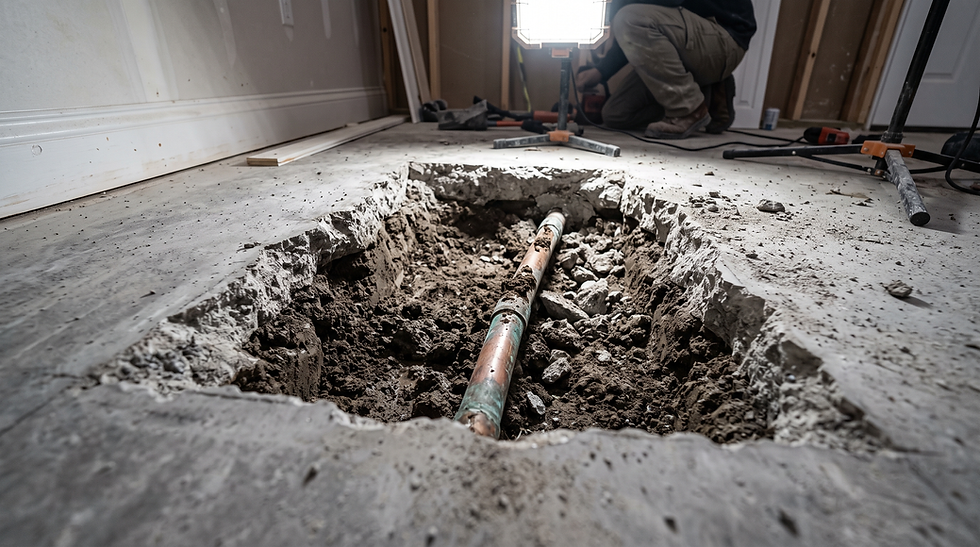
In Los Angeles, what is under the addition matters as much as the addition itself. The city requires Geology and Soils Reports for room additions on hillside properties, in seismic hazard and liquefaction zones, and similar conditions. As a working estimate, a standard California residential geotechnical report runs roughly $1,000 to $5,000, and a full report on a difficult site can reach $7,000 to $9,000 or more. LADBS requires the report approved before it issues building permits on qualifying sites.
This is the clearest reason two same-size additions cost differently. A flat-lot slab and a hillside caisson foundation (deep concrete piles drilled down to stable soil) can be a five-figure swing before a single wall goes up.
Structural Engineering
Most additions need an engineer. HomeGuide puts the structural engineering portion of a home addition at roughly $2,200 to $3,700, with total engineering fees often running 1 to 5 percent of the construction budget. Los Angeles seismic design adds real complexity here, which is part of why local projects sit above national averages.
Tying Into the Existing House
Industry cost estimators put additions at roughly 20 to 40 percent more per square foot than equivalent new construction, because you are joining new work to an old house.
That means opening exterior walls, adding structural headers and shoring, matching existing finishes, and upgrading current mechanical systems to carry the new load while you live in the home. Opening walls also tends to reveal what the original bid could not see: outdated knob-and-tube wiring, water damage, or asbestos, where abatement alone commonly adds $2,000 to $8,000.
HVAC, Site Prep, and Finishes
Your existing HVAC often cannot serve new square footage. A new system with ductwork runs $7,000 to $16,000, and a change-out without new ductwork is $5,000 to $11,000, per HomeGuide 2026 data. Site preparation adds another $1,500 to $5,000. Finishes are the most elastic line item in the project: upgrading a single category from builder-grade to premium can add $3,000 to $10,000.
Why Smaller Additions Cost More Per Square Foot
Fixed costs do not scale. Mobilizing a crew, pulling permits, setting up a foundation, tying into the roof, and managing the job cost roughly the same whether the addition is 100 square feet or 500. Those fixed costs spread across more square footage as the project grows, which is why a small 100-square-foot addition can carry a much higher per-foot cost than a 500-square-foot one. If a contractor quotes you a flat rate per square foot regardless of size, that is a sign the quote has not been scoped to your actual project.
What a Major LA Addition Actually Involves
To show what a large addition looks like in practice, here is a walkthrough of one of our projects, a home expanded from about 1,900 square feet to roughly 3,600 square feet, ending at five bedrooms and five and a half bathrooms with a new kitchen, wine cellar, walk-in pantry, primary suite, and rear sliding doors to the backyard.
A project at that scope is really a sequencing exercise. The foundation, framing, structural tie-ins, mechanical systems, and finishes all have to land in the right order, which is why we handle foundation and structural work in-house and run every addition through our design-build process with 3D renderings before anything is committed. Recent additions like The South Bay Expansion in Torrance and The Hillside Modern Addition in Woodland Hills followed the same path.
LADBS Permit Costs for a Room Addition
Permit cost is the area where online sources are most contradictory, with some pages quoting under $1,000 and others quoting $8,000 to $15,000. Both can be correct, because they are describing different things. Here is how Los Angeles actually calculates it.
LADBS permit fees are valuation-based. The building permit fee comes from the total construction valuation (the value of all the work, including finishes, electrical, plumbing, and HVAC) on a sliding scale set in the Los Angeles Municipal Code, Table 1-A.
Most room additions fall in the $100,000 to $500,000 bracket. A $200,000 addition produces a building permit fee of $395 plus ($3.50 times 200), or about $1,095. That is the number behind the permits-are-cheap pages.
The all-in number is higher because several fees stack on top of that base:
Plan check fee: 90 percent of the building permit fee. On a $200,000 addition, that adds roughly $986.
Separate trade permits: Electrical, plumbing, and mechanical are charged from their own fee schedules on top of the building permit.
State and city surcharges: Seismic instrumentation, an energy-compliance increase, and a development-services surcharge all apply.
Certificate of Occupancy: $150 per unit.
The City of Los Angeles publishes worked examples that settle the dispute. In its 2021 to 2029 Housing Element, a project valued at $121,200 carried a total permit fee of $8,447.62, while a $20,000 garage conversion totaled $1,045.22. So the bare building permit on a six-figure addition is around $1,000 to $1,500, but the all-in permit cost can reach $8,000 or more once every line item is included. When you read a quote, check whether the permit figure is the base building permit or the all-in total.
How Long a Room Addition Takes in Los Angeles
Timeline tracks closely with scope. Neutral and national sources converge on these ranges:
Standard single-room ground-level addition: roughly 3 to 4 months of construction
Full or complex addition: around 6 months
Second-story addition: 6 to 12 months including design, permitting, and construction
National renovation guides put the full process for a larger addition at 6 to 12 months, depending on size, permitting, weather, and contractor scheduling. In Los Angeles, plan an extra cushion for LADBS plan check, which runs several weeks on a straightforward project and longer for hillside, historic-overlay, or very-high-fire-hazard parcels.
Will a Room Addition Add Value to Your Home?
A room addition is a lifestyle investment first and a resale play second. The neutral authority here is the Remodeling Cost vs. Value Report, which tracks cost, resale value, and percent recouped by region.
Source: Remodeling 2024 Cost vs. Value Report, Pacific region (Zonda Media). The Pacific region, which includes Los Angeles, posted a higher cost-recouped percentage than the national average in every project category in the report.
Two things worth knowing. First, additions recoup a minority of their cost at resale, even in a strong market like LA. Second, adding square footage permanently raises your assessed value. As a rule of thumb, if the assessor adds 70 to 90 percent of construction cost, a $100,000 addition adds roughly $840 to $1,080 a year in property taxes at a 1.2 percent rate. Industry guidance is to carry a 10 to 20 percent contingency on top of the contract price. A quote that omits contingency and ignores the tax impact is not telling you the full cost.
Room Addition Versus ADU: Which Makes More Sense?
Many homeowners weighing an addition are also weighing an accessory dwelling unit. They solve different problems.
If you want more room in the home you live in, an addition is usually the better fit. If you want a self-contained unit for family or rental income, look at a garage conversion or ADU instead. Some homeowners do both, pairing an addition with a remodel as part of broader home remodeling work.
How to Read a Room Addition Quote and Spot a Lowball
The cheapest bid is often the most expensive one by the time the project finishes, because the gap between a low quote and a real one is usually made of the items above. A quote scoped to your actual home should account for:
The foundation and soil conditions on your specific lot
Structural engineering and any reinforcement needed
Permits, plan check, and the all-in fee total, not just the base building permit
Wet-room plumbing and electrical, if applicable
HVAC capacity for the new square footage
A realistic finish allowance
A 10 to 20 percent contingency
When a homeowner brings us two quotes that are tens of thousands of dollars apart, the difference almost always traces back to one of these being missing from the cheaper one. The way we handle it at Built to Perfection is to scope the project to your home, walk you through the cost drivers, and show you a 3D rendering of the finished space before you commit to anything, so the number you see is the number that holds.
Frequently Asked Questions
How much does it cost to add a bedroom in Los Angeles?
A bedroom is a dry room, so it sits on the lower end of addition costs. National data puts a bedroom addition at $125 to $175 per square foot, or roughly $15,000 to $25,000 total, before the LA premium. Adding an attached bathroom raises the per-foot cost significantly.
How much does a second-story addition cost in Los Angeles?
A full second story commonly runs $200,000 to over $1,000,000 nationally, with partial second stories in the $100,000 to $250,000 range. Building up costs roughly 1.5 to 2.5 times more per square foot than building out, driven mostly by foundation reinforcement, roof rebuild, and stairs.
How are Los Angeles building permit fees calculated?
LADBS calculates permit fees from the total construction valuation on a sliding scale (Table 1-A). The base building permit on a $200,000 addition is about $1,095, but the all-in total, including plan check, separate trade permits, and surcharges, can reach several thousand dollars.
Do I need a soil report for a room addition in Los Angeles?
Often, yes. Los Angeles requires Geology and Soils Reports for additions on hillside properties and in seismic hazard or liquefaction zones. The report runs roughly $1,000 to $5,000 and must be approved before LADBS issues building permits on qualifying sites.
Is a room addition worth it in Los Angeles?
It depends on your goal. Additions recoup a minority of their cost at resale, even in the high-ROI Pacific region, so they make the most sense when the added space improves how you live in the home long term, rather than as a pure resale play.
Get a Real Number for Your Addition
A per-square-foot rate cannot tell you what your addition will cost, because your lot, your existing house, and the room you are adding decide most of the number. We have built additions across Los Angeles County and Orange County for 25 years, with foundation and structural work handled in-house, permits handled from plan check through final inspection, and 3D renderings before you commit (CSLB License #837987).
If you want a real number scoped to your home, reach out for a free in-home consultation or call us at (888) 955-0535. We will walk you through the cost drivers on your specific project and show you what the finished space will look like before you decide.
Cost figures in this guide reflect neutral market data as of 2026 and are not quotes from Built to Perfection. Your project cost depends on your home, lot, and scope.