%202.png)
Slab Leak Repair in Los Angeles (2026): Signs, Costs, and Rebuilding What Gets Torn Out

Byline: Asher Ben-Haim
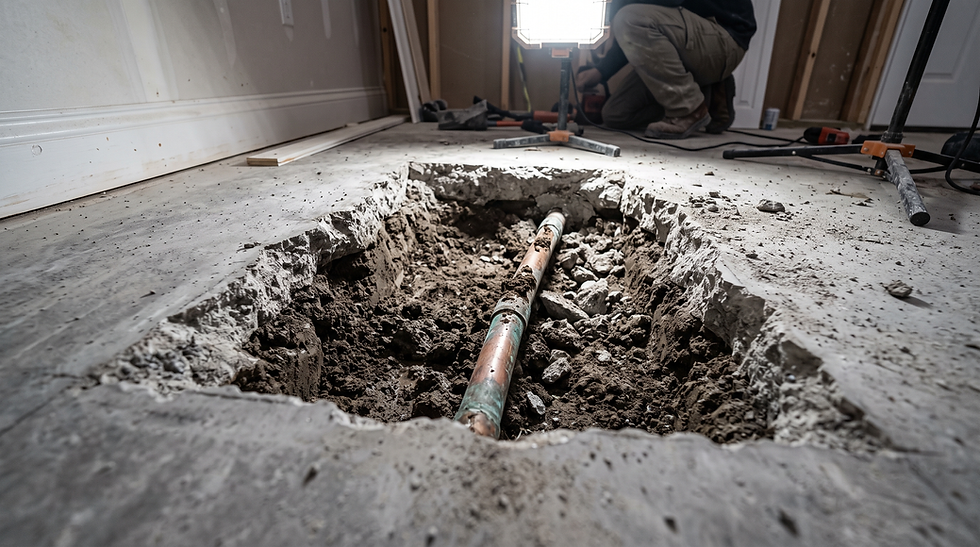
A slab leak is a leak in a pressurized water line running under your home's concrete foundation. Slab leak repair in Los Angeles is two jobs, and homeowners usually only hear about the first. Job one is finding the leak and stopping it, which is licensed plumbing work. Job two is everything job one leaves behind: an open slab, wet soil and subfloor, torn-out flooring, damp drywall, sometimes cabinets that came off the wall.
National guides put the pipe repair between roughly $600 and $15,000 depending on the method. On a leak that has been running a while, the rebuild is the larger of the two.
At Built to Perfection, we handle that second half. I'm Asher Ben-Haim, and I've been building and rebuilding homes across Los Angeles County and Orange County since 2001. We're an IICRC certified firm (Firm #70224833) for water damage restoration.
Most water losses get split between one company that dries the house out and a different contractor who puts it back together. We do both under a single scope. For the pipe itself, your first call is a licensed plumber or a leak detection specialist.
What Is a Slab Leak?
A slab leak is a leak in one of the water supply lines running under or through your home's concrete foundation. When one fails, the water goes into the soil beneath the slab and up into whatever sits above it, which is why you notice a symptom in the room long before anyone finds the source.
What Are the Signs of a Slab Leak?
The symptoms that bring most homeowners to the phone, and what each points to:
A warm spot on the floor. Usually a hot water line under that section of slab, heating the concrete above.
The sound of running water with every faucet closed. Water is moving somewhere it shouldn't be.
A water bill that jumps with no change in how you use water. A leak runs 24 hours a day, and it doesn't take much to show up on a bill.
Flooring that's damp, cupping, lifting, or stained in one area. Moisture is coming up through the slab.
A musty smell near that same area. Something has been wet long enough to hold moisture.
Water pressure that has dropped off. You're losing pressure in the supply line before it reaches the fixture.
The bill is worth doing the math on. A leak running at a tenth of a gallon per minute puts about 4,320 gallons into the ground over 30 days. At a full gallon a minute, it's about 43,200. The Los Angeles Department of Water and Power (LADWP) bills water in units of 748 gallons, and only the first 8 units bill at the lowest tier. A leak doesn't just cost you the water it wastes. It pushes your normal usage into higher-priced tiers, so the bill rises by more than the water is worth.
Can a Slab Leak Damage Your Foundation?
Water running under a slab can wash out the soil supporting it, and that mechanism is real. What nobody can tell you is how often that produces structural damage. No Los Angeles study puts a number on it, which is worth remembering when you read that every slab leak is a foundation emergency. New cracks, sloping floors, or sticking doors are worth a look from a foundation specialist, separately from the leak.
What Causes Slab Leaks in Los Angeles Homes?
Los Angeles has old housing stock. The city's median year built is 1965, against 1981 nationally, according to USC's Neighborhood Data for Social Change. That puts many homes well into the range where original supply lines start to fail. But age only takes you so far. The year your house was built doesn't tell you what your pipes are made of or how they were run under the slab.
One explanation you'll hear constantly is that concrete corrodes copper. The Copper Development Association says otherwise: copper tube can generally be embedded in concrete or placed in contact with it, and concrete on its own is not corrosive to copper. The sleeve you sometimes see where a pipe passes through the slab lets the pipe move and keeps the concrete from wearing on it. It isn't shielding it from a chemical reaction.
Pipes under a slab fail for other reasons. Water chemistry eats small pits into the pipe wall from the inside. Fast-moving water wears that wall down over time. Ground and structural movement stresses rigid pipe. And how carefully the line was installed matters as much as any of it.
The one factor you can actually check is your water pressure. The plumbing code requires a regulator on new residential plumbing wherever street pressure can exceed 80 psi, and LADWP sets its regulators to about 50 to 70 psi. Older homes may have none, because they were built before the requirement existed. You can get the pressure at your address from LADWP at no charge. In 25 years of building here, that's the one prevention step I'd tell any homeowner to take.
How a Slab Leak Gets Found and Stopped
Detection narrows down where the leak is so less of your floor has to come up. Acoustic equipment listens for water moving where it shouldn't, and thermal imaging reads the temperature pattern in the slab around wet soil or a hot line. Neither shows anyone a picture of a broken pipe, which is why more than one method usually gets used before anything opens. Be skeptical of any detection accuracy percentage: no residential study supports those numbers.
Once the leak is located, the repair method gets chosen, and that choice decides how much of your house comes apart.
No authority supports the idea that rerouting always beats a spot repair, or that a certain number of leaks means it's time to repipe. Four things decide it: whether a new route is possible, what condition the rest of the system is in, what's sitting on the floor above the failed section, and whether the work needs a permit. Repairing one failure and replacing an aging system are two different decisions, and they deserve separate prices.
How Much Does Slab Leak Repair in Los Angeles Cost?
As of 2026, national cost guides put the pieces of a slab leak repair anywhere from a few hundred dollars to $15,000, depending on method. Nobody publishes Los Angeles figures. No government agency, insurer, or cost publisher tracks pricing here, and the two that do publish don't line up on the decisions that cost the most.
Sources: HomeGuide and Fixr. These are national cost-guide estimates as of August 2026, not Los Angeles quotes. Look at the bottom three rows. On the smaller line items they agree almost to the dollar. On the expensive calls they don't, which is why nobody should hand you a single average.
The rebuild gets quoted separately, and it scales with whatever was sitting above the pipe. As of 2026, HomeGuide puts water extraction and drying at $4 to $12 per square foot depending on how contaminated the water is, and hardwood flooring at $7 to $25 on the same page. Drywall for a 12-by-12 room runs $580 to $1,800. Those are national figures too. Opening a slab in a bare garage and the same section under tile with cabinets on top are not the same job. For the wider picture, see our guide to water damage restoration costs in Los Angeles.
One note on our own pricing. Our minimum project size is $7,500 for any service. That's the smallest job we take on, not an estimate of what a slab leak costs, and a plumbing-only repair typically sits below it.
What the Rebuild After a Slab Leak Involves
Fixing the pipe stops the water. It doesn't tell you whether the concrete, subfloor, framing, drywall, and finishes around it are dry, and finding that out is separate work with its own standard. ANSI/IICRC S500, now in its fifth edition, assumes someone else has already corrected the source of the water, and treats drying, inspection, materials, and structural restoration as separate work. This is where water damage restoration becomes its own project rather than a cleanup step.
How long drying takes is confirmed by measuring, not by the calendar. No standard sets a number. The real time depends on how much water got in, how easily the materials absorb it, whether any is trapped under flooring, and the temperature and humidity while it dries. Speed still matters, and the reason is mold. The EPA advises drying wet areas within 24 to 48 hours to prevent growth, and the CDC gives the same guidance. That's advice for preventing mold, not a deadline after which mold is a given, and the EPA also notes that mold areas under roughly 10 square feet are often manageable without a specialist. A leak dried quickly ends up with a far smaller scope than one that soaked into walls for weeks.
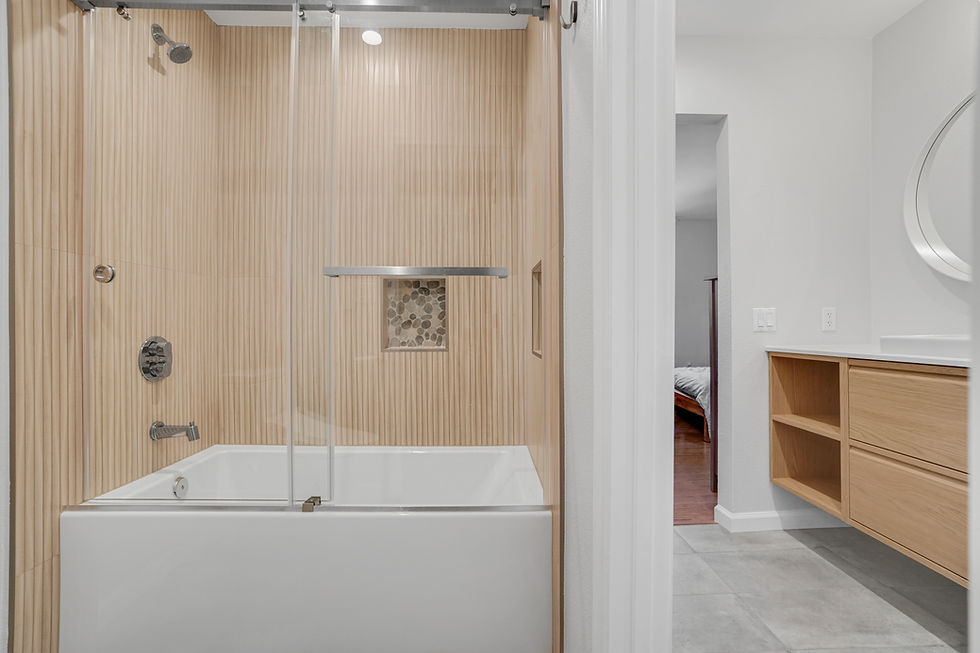
Two things shape how we run the reconstruction. The first is lead. Homes built before 1978 fall under the federal Lead Renovation, Repair and Painting rule any time painted surfaces get disturbed, and pulling baseboards, drywall, and flooring in a 1960s house is exactly that. We're an EPA Lead-Safe certified firm (RRP #LBP-F307833-1). The second is sequencing. Nothing gets demolished until everything needed to finish that phase is on hand, which matters when you're living in the house with your floor open. Once the affected area reaches a kitchen or a bathroom, the rebuild becomes room-scale home remodeling and gets scoped that way.
Do You Need a Permit to Repair a Slab Leak?
It depends on the method and the jurisdiction. A limited leak repair can be exempt in the City of Los Angeles. A reroute or a repipe generally is not. "A permit is always required" is not accurate. The 2025 California Plumbing Code took effect on January 1, 2026, and local jurisdictions adopt it with their own amendments on top.
In the City of Los Angeles, the municipal code broadly requires a plumbing permit for altering or replacing regulated plumbing, and exempts repairing leaks within defined limits. Replacing an underground water pipe with the same size and material falls under the Los Angeles Department of Building and Safety's express permits, with no plan check, and the pipe has to stay uncovered until a field inspector verifies it. A reroute or a repipe lands in the general permit requirement instead, with inspection and testing.
Unincorporated Los Angeles County runs plumbing under its own Title 28, so confirm requirements with LA County Building and Safety rather than assuming City rules apply. Unincorporated Orange County adopted the 2025 plumbing code in November 2025. If you're in Anaheim, Irvine, Santa Ana, Newport Beach, or another incorporated city, your own building department governs. Whether replacing finishes afterward triggers its own permit depends on the scope, and structural alteration to the slab deserves a local check. We pull permits on every project we run, and our Los Angeles construction permitting guide covers the wider process.
Does Homeowners Insurance Cover a Slab Leak?
That depends on your policy, and your carrier is the only one who can tell you. In general terms, the Insurance Information Institute lists accidental discharge of water from a plumbing system among the covered perils in several common homeowners policy forms, and separately notes that standard policies generally don't cover damage from lack of maintenance. Call your carrier before you commit to a scope of work.
We coordinate directly with homeowners' insurance carriers on covered losses, and we offer standalone insurance estimate work at $1,500 for homeowners who want documentation without committing to a rebuild. We're the coordinator and the builder, never the adjuster.
The Order the Work Happens In
Here's the sequence, and what falls to you at each stage:
Stop the water. Shut off the supply at the main. This one is yours, and the faster it happens the more it saves.
Get the leak located. Call a licensed plumber or leak detection specialist. Before you approve anything, ask what has to be removed to reach the pipe.
Choose the repair method. Your decision, with the plumber's input on what's feasible at your house.
Handle permits where the scope requires them. Whoever holds that contract pulls them, and the work stays open for inspection.
Get the structure evaluated for moisture. This is separate from the pipe work. What can be dried gets dried and monitored, and what can't comes out.
Address confirmed mold. The scope depends on what's actually there, not on a worst case.
Rebuild. Slab patching first, then subfloor, flooring, drywall, trim, paint, and cabinets or tile where they apply. Your job is picking materials, because matching what was there is often what holds up the schedule, especially if the original tile is discontinued.
Talk to Us About the Rebuild
If your plumber has been out and you're looking at an open floor, wet drywall, and a house you're still living in, that's the part we take. We'll assess what's actually wet, tell you what has to come out and what can stay, and give you one scope from drying through finished floor. Call (888) 955-0535 or reach out through our contact page for a free in-home consultation.
Built to Perfection, Inc. CSLB License #837987, Class B General Building.